Principle of particle physics, part 6.
|
Principle of particle physics, part 6.
|
The "dualisme of particle and corpuscles" is a keyword, which describes best another conflict of modern physics (in addition to the conflict between relativity and quantum mechanics). Light e.g. has a definitive wave character; this has already been known by Huygens and others some 300 years ago. But light behaves like a stream of particles. This can particularly be seen with respect to the energy of light. Every light quantum has a distinct energy and momentum, and these quantities are (largely) maintained, whatever happens to the light. Especially light does not deteriorate as water waves do (decrement of amplitudes).
Scientist have tried many things to find a concept, which might be conform with the wave character on the one side, but which also allows for the energy of a quantum to stay mainly constant with time. (Of course, there is the effect of light changing its energy in a gravitational field, and the cosmological red shift, which I explain as an aging effect due to gravitational interaction with matter.)
When I was a student, I heard repeatedly the words "gaussian wave packets" (which in recent times had a sort of revival in the "superposition of wavelets"). This seemed to suggest that every light quantum consisted of several particles, which - by some strange statistical effect - interact in the way that the energy stays constant all the time. This interpretation of a statistical superposition is suggested by the word "gaussian", as the Gauss bell curve applies to statistical superposition of individual events.
I found this concept quite intreaguing, and I tried to visualize, how the individual parts of the wave packet might look like. This thinking was quite near to the concept of virtual particles in quantum electrodynamics.
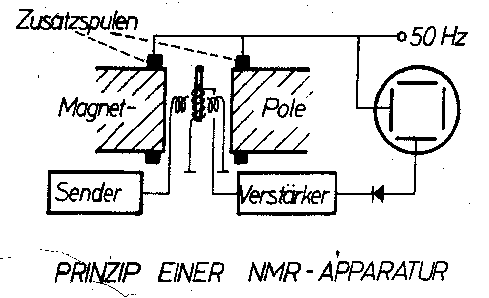
A few years later, I set up a NMR- spectroscopic metering system with extremely high sensitivity at the University of Hamburg. The experimental set up, I did, aimed at identifying the degree of polarisation of a very tricky polarised target. I realised that by metering the polarisation, I destroyed it. I was in a sort of dilemma. In order to keep the aparatus sensitive enough, I had to leave it switched on, but I had to keep it out of resonance in order not to destroy the polarisation. I thereby saw that a small de- adjustment did not work, because even then was the polarisation destroyed.
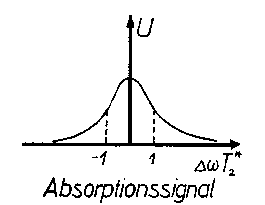
(this picture desribes the NMR- voltage against the frequency offset in units of the resonance line width for absorption resonance. The curve shape might be a Lorentz- curve or a Gauss- curve. This - due to thermal noise, cannot be decided directly.
I realized that I had at hand a unique method as to decide, whether the resonance curves of NMR- spectra are of Gaussian type or of Lorentz- Type (standing for a simple resonance effect). This - as I asumed - whould also give insight, whether the wave packets of light are of Gaussian type or of Lorentz- type; or - in other words -: the experiment would give me some indication, wheather or not the light quantum is a statistical superposition of individual quantum parts, which interacted in a strange and mystical way as to form a single light quantum.
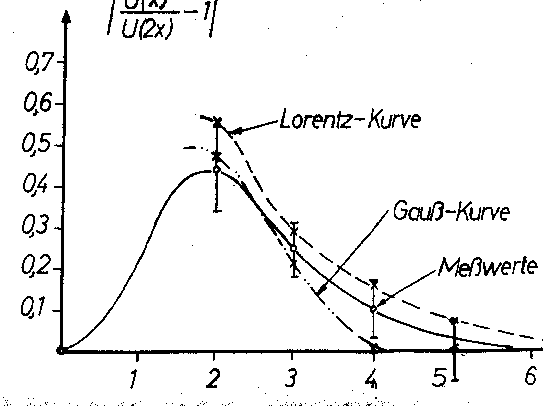
(The picture shows the rest polarisation of a sample, after it has been exposed to a radiofrequency field, which was out of NMR- resonance by a multiple of the half line width. In comparison the drawing includes the theoretical predictions for Lorentz- type of bell curve or the Gaussian type of bell curve.)
The experiment was simple: I deadjusted the aparatus by a multitude of the spectral line width, and then I adjusted it to resonance in order to meter the remaining polarisation. The results seemed conclusive to me: they showed that the NMR spectra are definitively more of the Lorentz- type than of the Gaussian type. I concluded that light - as other quantummechanical phenomena - are not a statistical superposition but an effect, which is somehow related to resonances.
Although I had still no idea, how light would lool like, this result convinced me that light generation and propagation is deeply rational. I had the feeling that we might eventually understand the nature of light in my lifetime. If the outcome would have been in favour of the gaussian type of curve, all my effords on understanding nature would have gone a different way.
In recent years, there have been quite some experimental evidences, which served to increase the mystification of light rather than to clarify its nature.
One series of those experiments dealt with the correlation of polarisation of two simultaneous light quanta. A very intelligent experimental setup was designet as to statistically allow the twin quanta to penetrate polarisators. And the remarkable result - as it seemed - was that one quantum can tell its twin quantum what sort of polarisation it has. The most remarkable thing was that this information exchange must have happened with a speed, which was higher than the speed of light.
Although I was very reluctant in accepting these conclusions, because I still saw the possibility that the polarisation was a property given to both twin quanta during their birth, I saw that these experiments might serve to further proof this ether model.
In particular I thought that the light quantum consists of three main parts: one is the triangular cavity in the front of the quantum, the second part is the set of ether bricks as they turn, until they have an orientation, which conforms with the resting ether bricks, and the third part is a crack pattern, which is generated by the first two parts, and which is normally spaced by the elementary length. This crack pattern - as I asume - has a dimension at least of the so called "coherence length" of light, or it might most likely even be larger.
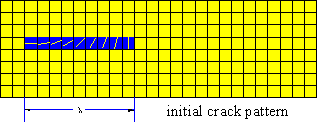
(Another simplified picture of a light quantum shows the inital crack pattern, which is generated by the quantum, which is thought to move from left to right. The crack pattern contains information as to the polarisation of the quantum, and it may also contain some information as to the wave length. The blue part shows the "main part" of the quantum, which consists of a number of ether bricks turning and thereby aligning perpendicular (or again parallel) to the original orientation. The initial crack pattern may be compared to the cracks generated by a ship, which moves through a frozen lake.)
So, this initial crack pattern bears the information on the polarisation of light, but it also may include some information as to the energy (=wave length) of light, e.g. by the dimensions of the micro gaps within the initial crack pattern. I think that - even if the energy is concentrated on the other two parts of the quantum (cavity and turning bricks), the initial cracks might have a non zero dimension, bearing a minute part of the energy.
And, I might add, that the light quantum has a gravitational field. This might be correlated with the initial crack pattern, or it might be the crack pattern itself, but in any case, this gravitational field has an energy content and thereby - according to the model - has microcavities in the ether.
So, the finding of the experiments on the twin quanta mentioned above, may further justify the ether model. It thereby does not increase the mystical, and nebulous picture of light, but it serves to demystify it.
Another set of experiments has been described in Scient. Amer. 11, 1996 by Kwiat, Weinfurter and Zeilinger. The experimental set up also involved polarisation devices and "twin light beams", but this time, a beam splitter assigned a single light ray to two different paths, where they were reflected and eventually reunited. This, of course, was a classical interference set up, much in the same way as a double slit set.
The novelty was that a polarisation twister turned the light a tiny fraction; additionally, the researchers includes a switchable mirror, which kept the light quanta in the device by multiple reflection, until eventually the switcher let the quanta escape; thereafter the polarisation was determined.
The experiments aimed at the goal of proving that it is possible to see in the dark. Normally, the light quanta had an orientation, which corresponded to the one path, which was more likely due to its polarisation preference. But when this path was obscured, all the light, which was reflected and monitored, had the orientation rectangularly to it. This is interpreted as an indication that the light quanta have "seen" that the originally preferred path is obscured and therefore have chosen the less probable path.
The authors claim that this set up is useful to "see in the dark", because the polarisation of the light is directly depending on the obstacle in the path, which the light quanta did not take.
I think that these experiments may directly prove the applicability of the ether model. In particular the said experiments seem to prove the existance of the initial crack pattern, which builds up far "upstream" of the main part of the quantum.
Further reading may be obtained from the web sites http://info.uibk.ac.at/c/c7/c704/qo/photon/#Inter and http://p23.lanl.gov/Quantum/kwiat/ifm-folder/ifmtext.htm
If You like more more information in german , please click here.
date of last issue: 23. 4. 1997
