 |
Principle of particle physics, Part 4.
|
The propagation of light rays has always been a puzzle. Too many different phenomena had been observed already at ancient times. At the times of Newton, Leibniz, Descartes and - last but not least - Huygens there were some confusing observations as to refraction and interference of light.
Newton dealt with refraction quite a lot. He was particularly fascinated by the appearence of rainbow colours with optical prismes, and some of his great reputation stemed from his mathematical formulation of refraction phenomena. He asumed (modeled) that light would be sucked into the optical dense media, whereby the speed of light increased as compared to the speed of light in air.
Of course, we know that he was not at all right in this asumption. But his mathematical formulations proved to be applicable, and therefore they became one of the foundations of optics.
Quite some "artists" dealt with light phenomena as well. The german poet Goethe, one of the greatest of all times, developed a colour theory, which was wrong from beginning to the end. Goethe wanted to disprove Newton espesially, and Goethe stated that Newton was wrong in saying that white light was a superposition of all colours.
German pupil still find Goethe's colour theory in their physics books. In fact, just recent school books celebrate a revival of Goethe's colour theory, and they put it side to side with other optical theories. This in itself may show how uncertain modern physics is about the foundations of optics.
One of the greatest achievements has been the principle of Huygens, who quoted that every point in space is the origin of "elementary waves" as light passes. So, the propagation of light is the superposition of elementary waves, which interfere.
This principle has been the leading theory for nearly three centuries; it e.g. explained satisfactorily the phenomena of refraction (with light having a reduced speed in the optical dense medium) and interference. It was primarily the observation of light quanta bearing a constant amount of energy (Planck and Einstein with his discovery of the light electrical effect, for which he won the nobel prize - and not his theory of relativity), which made it necessary to qualify the light theories.
Modern light theories are hardly worth the paper they are written on. Quantum physicists are particularly puzzles about the old model, which asumed that optical dense media have reduced speeds of light. E.g. the great R. Feynman states in his "lectures of physics" that the speed reduction is a wrong asumption; in reality the light should travel through optical dense media with the same speed as in vacuum.
This statement of Feynman is - of course - in contradiction to experimental findings. The speed of light has been measured extensively in all sorts of media, and the general finding was that - in fact - the speed is reduced.
This controversy shows, how helpless scientist are with optical phenomena today.
There are quite some optical phenomena, which can be modeled with the ether model. I want to show, how I model the refraction of light.
|
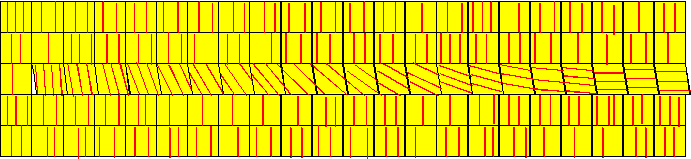
According to the ether model, light comprises two effects: It involves a triangular cavity at the front of the light quantum, and it involves a certain number of ether cubes, which turn, until the ether orientation is in line (or perpendicular) to the original orientation. The ether cubes in vacuum have typical dimensions of the "Compton wave length of the resting proton", or the classical electron radius, or the elementary length.
The light quantum in an optical dense body is looking very much the same, with the difference that the cubes are smaller in cross section, when being looked at from the side.
The basic idea is that the atoms in the glass body (or whatever medium we consider) lead to an additional crack pattern, which - in connection with the crack pattern of the light quantum - forms a crack pattern, which is essetially reduced in its spacing.
However, the model would be contradicting itself, if the geometry would be bases on pure cubic ether bricks. Instead, the ether bricks must have a slightly different geometry.
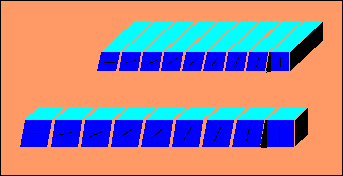 |
The drawing demonstrates in comparison to the light quantum in vacuum, which is shown below, that the quantum in glass (above) has the same number of bricks turning, and the same triangular angle as well as the same volume of the cavity.
This can only be achieved, if the ether bricks in the glass have an elongated form. It can be shown in simple mathematical treatments, that - by maintaining the volume of the cavity - also the moment of "spin" of all bricks is maintained as well as the kinetic energy of all bricks.
Thereby the length of the bricks must be larger by a factor, containing the square of the ratio of the cross sectional dimension.
The ratio of the cross sectional dimensions is equal to the "index of refraction", as well as to the ratio of "wave lengths", as the ratio of the speeds of light.
To take an example: in glass of about n=1.6 the cross sections of the cubes are only 0.625 of an elementary length, whereas the width of the bricks is increased to 2.56. This example may give some indication, why it is so difficult developing glass sorts of higher index than 2.0; thereby the width of the ether bricks would already be 4 times the original value.
The picture can also visualise that the "angular frequency" of the light "wave" is maintained during the transition from vacuum to the optical dense medium. This is an important fact, when one consideres the Fresnel's law of refraction and the Brewster law for complete polarisation.
The essential item is that the volume of the triangular cavity is maintained, when the light goes from vacuum into matter. Furthermore, the angle of the triangular cavity is maintained as well.
When light intrudes the rigid, transparent body, it incounters the surface first; this leads to a distribution of the cavity volume over several gaps, thereby establishing electrical and magnetical fields. After a while, the motion of all cubes leads to a new formation of the quantum in the medium of the said form.
In fact, this model still conforms to the Huygen's principle of superposition of elementary waves. But, in contrast to the old theory, this model asumes that the elementary waves reasemble and form a single quantum. This implies that the light cannot decrease "its amplitude", as the old theory holds. The elementary waves are part of one quantum, and they are just generated for a short while, when light incounters an ostacle.
Of course, there is the crack pattern, which accompanies the light quantum, which may serve to "tell" the quantum, if there are any obstacles in the vicinity, even if they are not in the direct "path".
As to the well known laws of Fresnel and Brewster concerning the polarisation of light, it can easily be shown that a light quantum, where the electrical field (direction of the triangular cavity) points towards the reflectred ray, cannot contribute to the reflection. This is in fact in line with the findings of Brewster and Fresnel.
This may suggest that the electrical "vector" is responsible for the propagation of light. On the other hand, the constancy of the triangular angle leads me to the asumption that the magnetic distortion during the "impact" of a light quantum on a surface is at least equally important. Here is an ample field for detailed numerical simulations.
This example shows in any case that many optical phenomena stay in line with the ether cube model. It is obvious that the model can be extended, and it may be modified, if some experimental findings do not correspond with the model.
There are presently two phenomena, which are generally seen to support the "theory of the big bang", which is also called the "standard model of physics" (by the way: who is setting up the standard?).
The first finding is the so called Hubble red shift (sometimes also called "cosmological red shift"). This Hubble law sumarises that the spectra of distant galaxies are in most cases shifted towards the long waves; in particular, the red shift is as larger as the galaxies seem to be further away.
The second finding is the so called "cosmic back ground radiation". This radiation corresponds to a "black body radiation" of 2.3 K or 2.5 K, and it comes to the earth very uniformly from all directions of the sky.
The standard model says that about 10 billion years ago (10,000 millions) the whole universe was born in a "big bang". This was a giant explosion, and since then all galaxies and all matter in the universe drift apart. The Hubble law directly seems to prove that the galaxies fly away from us, and the cosmic background radiation is interpreted as a sort of echo of the explosion.
When I first heard of the big bang theory, I had the feeling that it directly contradicts the principle of relativity. I thought that the whole universe should be a sort ob black hole, seen from the inside. And in the same way, as P. Jordan in the late 60-ies stated that stars never could bounce into a black hole, I thought that the universe could never gain additional energy or even gain additional space.
Since then, I have done quite some work on the big bang theory. I was puzzled, why so many brilliant scientists adopted the big bang theory as a standard model. In my opinion, there was no need at all to manifest any standard model about the origin of the universe within physics. Of course, the big bang model implies many religious questions, but there are no physical phenomena, which require the modelling of a beginning of the uniververse.
And, of course, as physicists do deal with the nature as it presents itself today, there is no room in physics itself for speculation, how all started and how it will eventually end.
Physics is a science and a science has never been subject to a "standard thinking". Even, if we could define some standard thinking in physics, it should be about common use of words, common scientific units, common way to publish findings. But never should the scientists of any science be forced to think uniformly along a standard model.
Furthermore, the standard model is far from being generally accepted. E.g. the Nobel prize winner Ting, whom I met when he was at DESY in the late sixties, once said: "I want to look, how nature is. I am not going to prove anybody´s theory." I fully agree. High energy physics is interesting on its own. There is no need to argue that further experiments would yield more insight into the first seconds after the big bang. The experimental findings in high energy physics are fascinating and even thrilling in themselves, and they lose quite some of their attraction when they are linked with religious questions - one way or the other.
I was tought by my teachers that physical laws are supposed to apply for all times and all spaces. This general law seems to be justified by the spectra of distant galaxies, but it does - of course - not apply for the big bang. In fact, all physical laws are limited to the times after the big bang, and I do not know, how the standard model allows the physical laws to come into operation; at least, the energy conservation law does not seem to be valid for the standard model as long the so called "inflationary phase" happened.
These remarks may clarify that I am not at all a friend of the big bang theory. I regard the physicist, who defend the big bang model violently, as driven by a sort of chorporal spirit: all people, who think different to their own thinking, are automatically enimies.
Due to the political responsibility, Germany has with respect to the times from 1933 to 1945,and being a german, I have learned that this attitude cannot be accepted. And I have learned that many arguements of the proponents for the standard model of physics have been used in very much the similar way in Germany for many centuries in the fight between the various christian religions - and in the fight of all christian religions against people of different confession.
I have assessed the standard model very carefully, and all the model boils down to, is in fact just the two findings of the cosmological red shift and the cosmic background radiation.
The results of my evaluations are twofold:
- The cosmological red shift is an aging effect of light: as the light quantum passes through the universe, it attracts all the stars and matter towards its path. This attraction is a pure gravitational effect. These effects are very small, since the light quantum has a very small "mass" as compared to a star, and therefore this effect has been overlooked. But this effect can be calculated.
I have asumed that there is an average, uniform density in the universe. Then the wave length of a light quantum increases exponentially with time t according to the law:
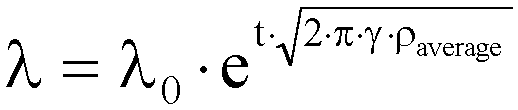
The standard model of physics has the same formula, except of a factor 8/3 in the square root instead of "2". This marginal difference shows that the Hubble law is quite in line with the big bang model and the light aging effect.
So, from a mathematical point of view, the big bang model and my attempt using the aging effect are equivalent with respect to the Hubble law.
Quite different is the matter with respect to the cosmic background radiation. It is said that this microwave radiation, representing a black body radiation of 2.5 K, is a sort of echo of the big bang. The standard model does, however, not have any explanation how the radiation of the big bang was reversed and echoes in the universe back and forth; what sort of wall was it, which reflects the big bang radiation? was there even more than just the big bang in an otherwhise empty universe?
I remind at my considerations about the nonexistance of black holes; the light cannot be reversed, as the simple minded black hole theory holds; and this does also apply for the big bang. However big the gravitation of the beginning universe was, it could not reverse the radiation. Instead, it might have reduced the energy, but the radiation left the location of the big bang with the speed of light, and would still do so. So there is no chance for us to see the echo of the big bang.
On the other hand, the cosmic background radiation is there, and it is a rather strong radiation. The question was for me, what is it out there in the depth of the universe, what radiates at 2.5 K.
The answer was quite intriguing: it is not at all a body or anything at 2.5 K. Instead, the radiations stems from free electrons in the universe, and it is the "black body radiation of free electrons at about 5000 K". Since free electrons have quite a different thermal radiation than the black bodies as examined by M. Planck, they just "pretend" as if radiation comes from a very cold body of 2.5 K. Instead the electrons have adopted the temperature of suns and stars, and these are typically in the range of 5000 K. The thermal radiation of free electrons differs to the black body radiation by a factor of roughly 2000 (in the Wien constant).
My considerations to this theme are very complex, and is is not necessary to elaborate all arguements at this place. It may be sufficient to show that there are severe conflicts within the big bang model, and that there are other phenomena such as the thermal radiation of free electrons, which have not been considered properly as to safely exclude them.
In connection with the aging process of light due to the gravitational energy transfer, there are no real arguements left for the big bang. Instead we may say that nothing contradicts the old principle that physical laws are valid for all spaces and all times.
The big bang did not take place.
date of last issue: 17. 4. 1997