 |
Principle of particle physics, Part 3.
|
I still remember in the late sixties, when astronomers were enthousiastic about first findings of gravitational waves, which seemed to give proof for the existance of black holes, when P. Jordan, one of the leading scientists in cosmology, raised some questions publicly. He argued that black holes are - due to the obvious reasons - impose a "relativistic bending" as well on space as on time; P. Jordan argued further that, due to the singulartities of the black hole, a star, falling into the black hole, never could reach it, because - according to relativity theory - the falling time would be infinitely long. He pointed out that this is not just a matter of our observation, it is a real consequence of relativity that the star never would plounge into the black hole. Of course, he added, there was still the question, if we could at all register any gravitational wave, since it could probably not excape from the gravitational field of the black hole.
As my laboratory was near P. Jordan's office, I was very interested in his reasoning. I found it convincing. And I was a bit sad, when I realised that physics generally ignored P. Jordan's critics. It was almost like a gold rush, which made physicist to hunt for black holes.
And this gold rush feaver still seems to exist.
Based on the reasoning of P. Jordan, I was encouraged to do some thinking about black holes myself. I found that the black hole theory had some vital errors. The most important one was a completely oversimplified view of light propagation in the vicinity of a body with strong gravitational field; I found, when light is emitted by a star with strong gravitational field, it never can turn backwards as the theory holds; instead, a more detailed calculation showed that light generally escapes the gravitational field of any "black hole"; it admittedly will encounter a tremendous red shift, but it will propagate "to the top" and finally leave the stars gravitational field, and it will leave it - of course - "with the speed of light". So, black holes cannot be black at all. They just seem red shifted, and, in fact, they seem just as observations of spectra of many quasars show.
This finding satisfied me that modern physics has in fact quite some open questions which are worth further word.
It became evident for me in the subsequent years that there are some fundamental assumptions, which never have been questioned.
One of these assumptions is that the empty space is empty.
As Feynman's quantum electrodynamics suggests (quite in line with Youkawa's first meson field model), the empty space is not at all empty. It is filled with all sorts of virtual particles. But still, the "space between the virtual particles" is asumed empty. But, since there are infinite virtual particles everywhere with finite wave lenth, all spaces - according to quantum elecetrodynamics - should be filled with an infinite number of particles at the same time. So, by consequence, modern physics does not allow for any space to be empty; instead, all space points are occupied by infinite numbers of virtual elementary particles.
Another assumption, which never has been questioned, are the conclusion of Rutherford's experiments. As we all know, this experiment allowed N. Bohr to formulate his fameous nuclear model. Thereby he described the atom as an essentially empty space, which is occupied in its centre by the atomic nucleus, which is surrounded by the electrons, much alike the planets surround the sun within our solar systems.
Although quantum mechanics finally lead to abandon the orbital motion of electrons, replacing it by the "probability function", the Bohr model still is a sort of leading model. This may even be recognised by the fact, that the parts, where electron probability function is high, are called "orbitals" in remembrance to Bohr's orbits.
In contrast, nothing keeps the nuclei in their position than the forces of the surrounding atoms. So, the wave lengths of e.g. the protons within a molecular complex can be calculated; this is generally in the order of Angstoms rather than pointlike.
One of the most important clues in favour of the ether model is the energy content of electrostatic fields. The energy density of an electrostatic field calculates as the product of field strength and space charge density. So all volume elements in an electric field are assigned an energy density.
Unfortunately, the sum of all energies in the vicinity of a pointlike elementary charge sums up to infinity. Physicists have asked, how near to a point charge, they may sum up the energies in order to get a total energy just as large as the (mass) energy of an electron, and the answer was the so called classical electron radius. This is just nearly as large as the elementary unit length, or the generally accepted proton radius (e.g. the Compton wave length of the resting proton).
So, the electric field of a pointlike elementary charge seems to contain all the mass of an electron at rest, and it contains the mass outside a distance of the classical electron radius.
There is no rest energy or mass left over for the pointlike body of the electron, unless one allows for some virtual exchange particles to constantly swap the energy between centre of the field and the field itself.
The ether model attributes the energy density to the cracks in the ether; thereby the volume of the cracks stands for the energy density. There is no pointlike source of the field; instead the field centres itself, and the basic mechanisme is the turning of a cube just as in the analogy of the turned card deck.
There is hitherto no easy explanation as to the nature of an electron within the ether model. I think, the electron might be modelled by ether cubes, which pulverise, and the powder migrating through the cracks of the ether and compressing in an alligned manner at a different location.
|
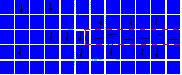
In contrast to the proton, the ether cubes are not turned as a whole. Instead the cubes pulverise. The powder creeps through the cracks, thereby eventually finds a different orientation. Only, when the powder has found this new orientation, it is allowed to allign in the red highlighted area.
The small cubes represent the powder grains, as they creep through the cracks. With this view, a negative charge may be represented by a source of powder. A positive charge, in contrast, is a deficit of powder as compared to the normal level. As the picture can show, a deficit of powder represents a positive empty volume. Similarly, a surplus of powder does also represent a positive empty volume. Thus a positive and a negative charge can both contribute to a positive energy density.
It is essential that this process is - as with the proton - gouverned by the geometry of the ether, whereby the dimensions of the ether cubes is of vital importance to the electric field
The question is, how do we setup the ether model. The question cannot be: "Are there any proofs or disproofs for the ether model".
date of last issue: 14. 4. 1997